 Yearn
Yearn
Yearn fees: Vault Charges and Gas Costs
Yearn fees can include management charges on deployed capital and performance charges on strategy profit, with rates set for the selected vault. Personal transaction gas adds a separate cost to deposits and withdrawals. V2 generally collects vault fees when strategies report, while V3 can charge inside tokenized strategies and through an allocator vault’s accountant. Both the vault version and deposit path affect the total cost. Fee settings vary by deployment. Swap-based deposits and exits can add conversion costs, and a withdrawal loss has a different cause from a management or performance charge.
Last updated ·
Costs at deposit, harvest and withdrawal
Depositing can incur gas for a token approval and the deposit itself, depending on the existing allowance and transaction method. An approval authorizes a particular contract to spend tokens. A vault deposit establishes the position that earns yield. An existing allowance can make another approval unnecessary. When the starting token differs from the vault’s accepted asset, a conversion route can add swap fees and price impact. Those costs arise before the vault begins managing the deposited asset.
During a holding period, strategies generate income and report their accounting results. Fee assessment follows the relevant contract’s rules. At withdrawal, personal gas returns to the cost calculation, and freeing assets from strategies can require additional execution. A subsequent swap into another token introduces its own terms. Vault management fees, strategy expenses and wallet transaction costs therefore appear at different points and use different calculation bases.
The deployment behind a fee quote
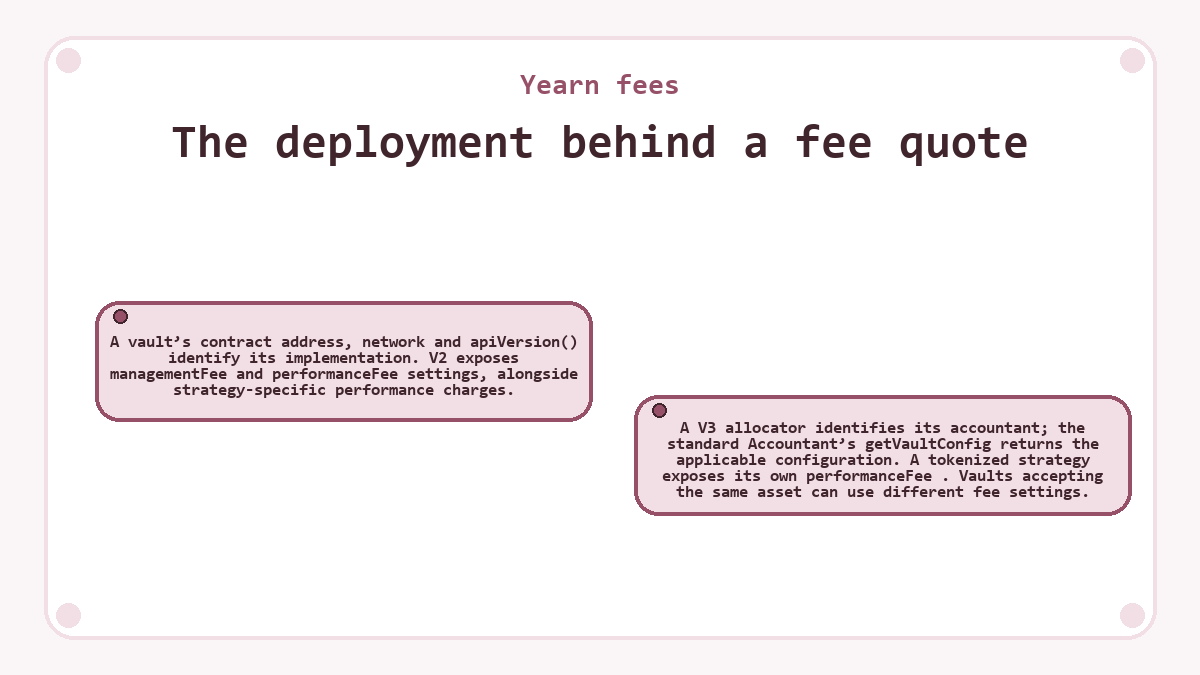
A vault’s contract address, network and
apiVersion()
identify its implementation. V2 exposes
managementFee
and
performanceFee
settings, alongside strategy-specific performance charges. A V3 allocator identifies its accountant; the standard Accountant’s
getVaultConfig
returns the applicable configuration. A tokenized strategy exposes its own
performanceFee. Vaults accepting the same asset can use different fee settings.
V2 management and performance accounting
A V2 management fee uses an annualized capital basis, while performance fees use the gains that a strategy reports. These percentages cannot simply be added into one annual charge. A performance percentage applies to profit, not automatically to the whole deposited balance. The original V2 fee model replaced the conditional withdrawal charge used in V1. Yearn no longer supports V1 vaults, so their historical withdrawal terms need their original version context.
In V2 API version 0.4.6, management accounting uses elapsed time since the strategy’s previous report. Its capital basis is strategy debt minus delegated assets. Here, debt means vault capital allocated to a strategy. Performance accounting includes the vault’s configured charge and the strategy’s separate strategist charge. The contract issues fee shares to recipients, spreading the economic effect across existing shares. A depositor does not receive a separate wallet invoice for each harvest.
V2 API 0.4.6 skips fee collection when a report contains no gain and caps combined fees at the reported gain. A personal balance multiplied by an annual rate therefore does not reproduce every harvest charge. Reporting timing and strategy accounting inputs also affect the calculation.
How do V3 strategy and allocator fees combine?
A V3 allocator deposit can carry both underlying strategy fees and the allocator’s own accountant charges. A direct deposit into a tokenized strategy has that strategy’s fee structure. The same underlying asset can therefore have different fee exposure through different vault arrangements.
Strategy fee recognition
Report-based profit
Report-based tokenized strategies assess performance fees when they recognize profitable reports. Fee shares represent the amount due to the fee recipients. The performance calculation uses strategy profit measured in its underlying asset. The standard TokenizedStrategy model has no separate annual management charge. The strategy’s quoted rate covers this layer; an allocator holding its shares can have additional charges.
Live accrual
TokenizedStrategy API version 3.1.0 also supports strategies that opt into live asset accounting. In that mode, state-changing accruals can recognize profit and assess fees between reports. The default strategy accounting remains report-based. This distinction affects the timing of charges, so the broad V3 label does not establish that all performance fees wait for a harvest.
Allocator accountant charges
A V3 allocator’s accountant calculates fees during strategy reports. The standard Accountant calculates management charges from allocated strategy debt and elapsed time, plus performance charges on reported gains. It can also apply a configured cap on total fees relative to gains. Custom accountants can use different logic. An allocator without an accountant assesses no accountant fees, while its underlying strategies can still charge their own fees.
Fee percentages at these layers can have different denominators. An allocator’s gain reflects the value of its strategy position after strategy-level fee effects. Its management charge uses a capital-and-time basis. Comparing the combined asset deductions avoids treating every percentage as a charge on the same original profit.
The protocol fee within collected revenue
A V3 protocol fee takes a configured portion of assessed fees, rather than an additional percentage of depositor profit. The corresponding factory supplies the applicable setting, including any deployment-specific override. The remaining fee shares go to the strategy’s designated recipient or the allocator’s accountant. A zero protocol-fee setting changes that revenue split while leaving the strategy or accountant’s own configured charges intact.
Fee ceilings and accounting units
Contract ceilings bound the values that fee setters can configure; active settings determine the actual charge. The standard V3 Accountant has its own management and performance limits. Custom accountants can follow other rules. TokenizedStrategy API version 3.1.0 limits its performance fee setting to 50% of profit. Each ceiling applies to the named implementation.
| Fee parameter | Fixed unit or implementation limit |
|---|---|
| Fee percentage denominator | 10 000 basis points represents 100% in the listed implementations |
| Accounting year in V2 API 0.4.6 and the standard V3 Accountant | 31 556 952 seconds for management-fee annualization |
| Standard V3 Accountant management-fee ceiling | 200 basis points, or 2% annualized |
| Standard V3 Accountant performance-fee ceiling | 5 000 basis points, or 50% of reported gains |
| TokenizedStrategy API 3.1.0 performance-fee ceiling | 5 000 basis points, or 50% of profit |
| VaultFactory API 3.1.1 protocol-fee ceiling | 5 000 basis points, or 50% of assessed fees |
Is a withdrawal shortfall always a Yearn fee?
A withdrawal shortfall can reflect strategy losses or conversion costs, so a smaller received amount alone does not identify a Yearn fee. V2 removed the V1-style withdrawal charge. Its withdrawals can nevertheless realize losses when assets must leave a strategy position. Retrieving idle assets and unwinding invested assets involve different execution work. The distinction affects gas and available proceeds even when the vault charges no percentage exit fee.
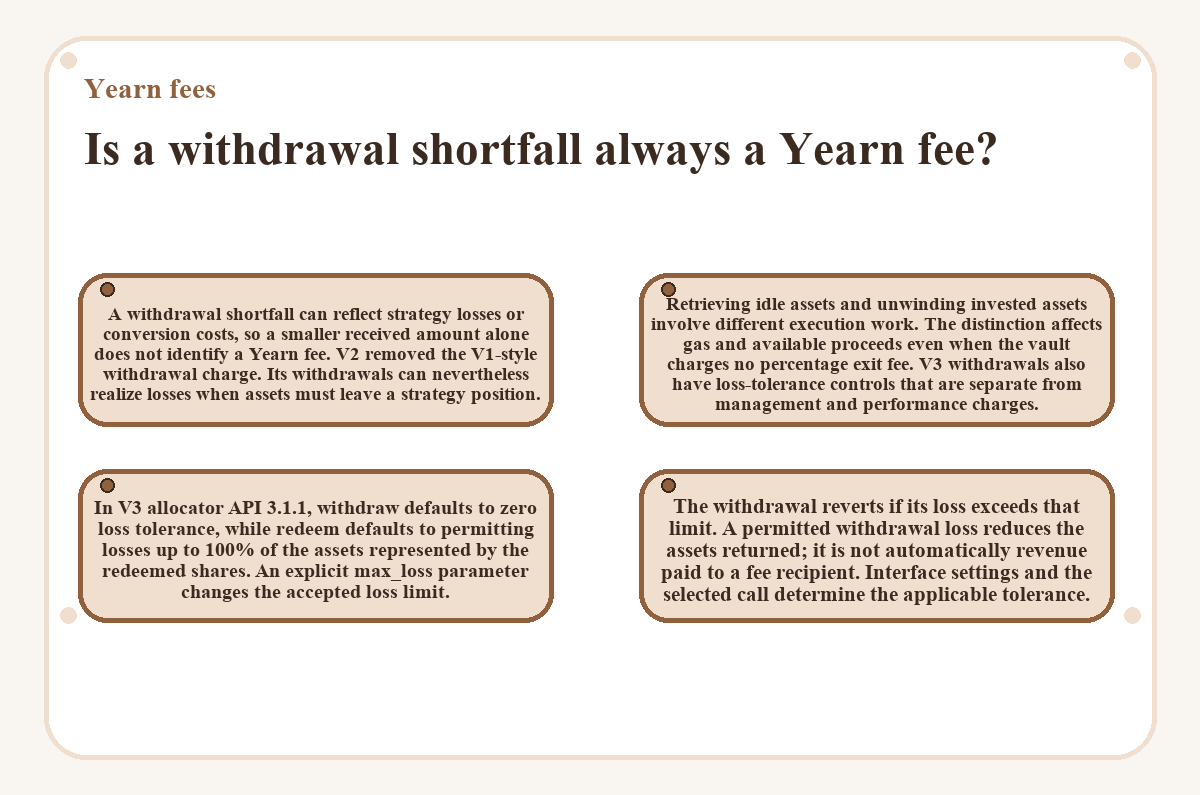
V3 withdrawals also have loss-tolerance controls that are separate from management and performance charges. In V3 allocator API 3.1.1,
withdraw
defaults to zero loss tolerance, while
redeem
defaults to permitting losses up to 100% of the assets represented by the redeemed shares. An explicit
max_loss
parameter changes the accepted loss limit. The withdrawal reverts if its loss exceeds that limit. A permitted withdrawal loss reduces the assets returned; it is not automatically revenue paid to a fee recipient. Interface settings and the selected call determine the applicable tolerance.
Wallet gas and pooled strategy expenses
Network gas pays for blockchain execution, including the work needed to enter or leave a vault. On Ethereum, execution cost equals gas used multiplied by the effective gas price. Network demand changes the base fee, and transaction priority can affect the price paid. A withdrawal that must retrieve assets through several strategy operations can consume different gas from a withdrawal served by idle assets. An exit estimate needs the withdrawal’s execution path and gas price.
Yearn pools strategy operations across deposits, allowing maintenance work to serve multiple depositors. This shared execution differs from the wallet-funded cost of an individual deposit or withdrawal. Fee revenue can support operating expenses, including strategy gas. Depositors should therefore distinguish the vault’s embedded costs from the network charges on their own transactions.
Keeping a gas-paying balance available matters at exit too; vault shares alone cannot pay an Ethereum transaction’s network charge.
Conversion costs around vault deposits
A zap combines asset conversion with a vault entry or exit where that route is supported. Its quoted economics can include provider charges and swap fees, alongside price impact from trading the selected amount. Availability depends on the vault, token and integration. Holding the vault’s accepted asset permits a comparison with direct deposit costs, without assuming that every conversion route exists or carries the same charge.
Slippage tolerance controls the acceptable movement in execution output. Increasing tolerance permits a worse conversion outcome; it does not reduce the provider’s stated fee. A quote’s expected output and minimum output describe different amounts. Conversion cost comparisons need the same input asset, destination asset and amount, with network gas accounted for separately.
Does displayed APY include every cost?
Yearn’s displayed net APY reflects vault fees but excludes the wallet’s personal gas costs. APY means annual percentage yield. External conversion charges also require their own treatment when they occur outside the vault return calculation. Gross strategy figures and net vault figures apply different fee treatment. Comparisons need the same basis.
Subtracting a performance fee again from a return that already includes it counts the same charge twice.
Holding periods and comparable cost totals
A consistent cost comparison separates deductions already reflected in vault value from personal expenses paid outside the vault. Entry and exit gas have greater relative weight when the position earns little before withdrawal. Management charges depend on the relevant capital and time inputs. Performance charges depend on recognized gains. A break-even calculation needs actual transaction expenses and net earnings over the holding period.
Costs quoted in different assets need a common valuation basis before they can form one total. Token-price movement can change a displayed monetary balance without creating a vault management charge. Net proceeds also reflect strategy income and realized losses.
V2 API 0.4.6 records calculated management, performance and strategist components in its
FeeReport
event. The event’s components are calculated before the gain cap; the charged total is the smaller of their sum and the reported gain.
Quick answers about Yearn fees
Can my Yearn management fee change after a deposit?
A vault’s authorized fee setter can change management fees within that implementation’s rules. Depositing does not lock the rate for the life of the position. The active contract configuration governs the charge, so a saved quote describes the setting when it was taken.
Will a reverted Yearn deposit still consume gas on Ethereum?
An Ethereum deposit transaction that executes and reverts still incurs gas for the work performed. The revert undoes the contract’s state changes. A transaction rejected before blockchain inclusion has a different status, and a pending transaction has not yet established its final execution charge.
What happens to management charges when a standard V3 Accountant receives a zero-gain report?
The standard V3 Accountant can calculate management charges even when a report has no gain. A positive maxFee setting caps total fees as a fraction of that report’s gain, which reduces the charge to zero in this case. A zero maxFee disables that cap.
Are vault performance fees charged on a rise in the deposited token’s market price?
V2 and standard V3 performance fees use gains measured in the underlying asset. A market-price increase alone revalues an unchanged holding without creating additional asset units. Strategy earnings and the token’s monetary valuation therefore describe different changes, even when a portfolio display combines them into one balance.
Can a standard V3 Accountant reimburse an entire strategy loss?
An accountant refund depends on its configured refund ratio and available underlying assets. Full reimbursement requires a sufficient ratio, funding and allowance for the vault to pull the assets. The refund mechanism’s existence alone does not establish that every loss will receive full repayment.
Does disconnecting a wallet stop Yearn management charges?
Disconnecting a wallet from an interface leaves its vault position on the blockchain. Management-fee accounting continues under the contract’s rules because the connection controls interface access, not the position’s accounting state. Closing the browser also leaves any shares held by that address unchanged.
Which gas figure determines an Ethereum vault transaction’s execution fee?
The execution charge uses actual gas consumed multiplied by the effective gas price. A wallet’s maximum fee estimate reserves room for execution and changing network fees; it is not necessarily the final debit. Unused execution gas is not charged as though it had been consumed.
Is a V3 Accountant’s default fee configuration always the one applied to my vault?
The standard V3 Accountant can use a custom configuration for a particular vault. An enabled custom configuration takes priority over the default. Removing that override restores the default settings, so the applicable configuration matters more than reading the accountant’s default rates alone.