 Yearn
Yearn Vaults and Automated DeFi Yield
Yearn automates decentralized finance (DeFi) yield strategies through vaults that pool deposits and reinvest earnings from underlying protocols. Depositors receive shares representing their portion of a vault’s assets. Its wider ecosystem includes liquid lockers, governance staking and lending-market curation, with different income sources and exit conditions.
Last updated ·
Vaults, strategies and curated lending
Vaults handle pooled assets and share accounting; strategies put those assets into particular yield-generating positions. A lending strategy can earn interest from borrowers. Liquidity strategies can collect trading fees or protocol incentives. Each vault selects its own combination of income sources. Allocation machinery can move capital among the strategies selected for a vault. Multiple strategies can spread exposure, although their positions may share dependencies on the same external protocol or asset.
V3 separates standalone tokenized strategies from allocator vaults. Where a strategy accepts direct deposits, that position follows its particular yield-generating implementation. An allocator vault can distribute assets among several compatible strategies and change their allocations. Developers can build both types using the V3 framework, including products operated by parties outside Yearn. V2 vaults remain relevant to liquidity-pool positions, including Curve pools. Their integration interface differs from V3, so an integration that supports one version need not support the other.
Yearn’s curation work on Morpho adds market selection and risk management to lending vaults. Curators choose permitted markets and influence how deposits spread between them. Monitoring covers changing allocations, collateral liquidity and borrowing utilization. A lending vault’s contract code and its market composition are separate concerns: the markets receiving funds can change. The exposure follows those allocations, even when the vault’s name stays unchanged. Curation manages these choices while the lending protocol supplies the underlying markets.
A vault deposit creates an asset-management position without opening a personal loan or establishing collateral for personal borrowing.
What does a vault share represent?
A vault share represents a proportional claim on the assets that the vault accounts for on behalf of its depositors. In an ordinary yield vault, returns normally increase the underlying assets backing each share. Your share count can stay unchanged while that backing grows. Losses and fees can reduce the claim’s value. V3 vaults use ERC-4626 to standardize asset deposits and share redemptions. The conversion between shares and assets describes vault accounting; it does not promise an immediately executable exit.
Specialized products can separate the deposited position from its reward-compounding token. yBOLD represents BOLD deposited across Liquity V2’s Stability Pools. Bare yBOLD does not accrue yield on its own. The associated auto-compounding vault, ysyBOLD, captures and reinvests Stability Pool rewards, increasing its backing relative to yBOLD when it earns profits. Stability Pool losses or poor execution when selling collateral rewards can affect the product’s principal.
Variable yield and vault costs
Vault earnings follow borrowing demand, trading activity and the incentives available to the selected strategies. A displayed net annual percentage yield (APY) estimates an annual return after vault fees, including compounding assumptions. In a V3 tokenized strategy, reporting recognizes profit or loss in the strategy’s accounting. An allocator vault separately processes the strategy’s report. Configured profit unlocking gradually incorporates gains into share value. This accounting process is separate from any withdrawal cooldown.
Performance fees charge against earned profit, while configured management fees charge over time against managed capital. Fee settings vary between deployments. V3 also allocates part of collected fees to the protocol through a governance-controlled fee configuration. Network transaction costs remain separate, and a conversion route can introduce swap costs or slippage. For a given transaction cost, a smaller deposit or shorter holding period leaves less yield to absorb that cost.
The relevant fee settings and transaction estimate belong to the chosen contract and route, even when several positions accept the same asset.
How do yLockers change the exit route?
Liquid lockers exchange an underlying governance token for a tradable token representing a locked position in an external protocol. yCRV can be minted from CRV or bought on a decentralized exchange. Minting places CRV in Curve’s vote-escrow system, where Yearn uses the locked position for governance benefits. yCRV cannot be redeemed for the CRV locked in its backing position. An exchange exit sells yCRV at market value, which can differ from CRV’s value and requires available liquidity. Unstaking the locker token leaves the underlying governance tokens locked.
yCRV holders can stake through YearnBoostedStaker to receive rewards linked to crvUSD, or use the yCRV Auto-Compounder to earn more yCRV. The staking rewards are distributed as yield-bearing vault tokens, so they carry their own vault exposure. The auto-compounder reinvests rewards into the locker position. yPRISMA is a legacy, deprecated yLocker product.
YFI staking and governance
YFI is the ecosystem’s governance token, with stYFI giving YFI stakers direct governance participation and rewards funded by protocol revenue. stYFIx delegates voting power for a more passive governance position. These tokens serve a different purpose from shares in an asset-yield vault. Governance proposals address ecosystem decisions and relevant protocol settings, while individual vaults have their own management roles. Unstaking stYFI or stYFIx starts a linear cooldown for the unstaked YFI, which becomes progressively available to withdraw. Adding funds to an active cooldown resets that position’s timer and relocks amounts that had become withdrawable. Legacy veYFI is deprecated, and migration is restricted by the snapshot’s eligibility rules and whether the address has already migrated.
Can vault assets always be withdrawn immediately?
Vault redemptions depend on available liquidity and the selected contract’s withdrawal rules, so immediate access is conditional.
A lending strategy may struggle to return assets when borrowers have consumed the available lending liquidity. Leveraged positions can face liquidation, and liquidity-pool strategies can suffer losses when relative token prices change. Vaults also inherit the smart-contract risks of their strategies and external protocols. Holding shares preserves the accounting claim, but recovering assets depends on available idle assets or the ability to unwind strategy positions. For V3, current withdrawal and redemption limits help describe available access. A V3 withdrawal reverts if its realized loss exceeds the transaction’s loss tolerance.
yvUSD can hold local strategies alongside cross-chain positions, bringing remote settlement and bridge dependencies into its cross-chain allocations. Remote assets contribute to vault accounting but must return to the origin chain before redemption. Available local liquidity can support an immediate exit; remote capital can require additional settlement time.
The optional Locked yvUSD wrapper adds a cooldown and withdrawal window for designated shares in exchange for additional yield funded by vault fees. Its management can change both time settings. When cooldown enforcement is disabled or its strategy is shut down, the wrapper can bypass its timing checks. Shares placed in an active cooldown cannot be transferred, while underlying liquidity still affects redemption. The base vault, cross-chain allocations and locking wrapper therefore contribute separate access conditions.
Vault selection and withdrawal terms
A vault shortlist starts with the intended deposit asset and the conditions for recovering it. Apply the same withdrawal-access criterion to a direct strategy position and an allocator vault. A cross-chain position adds settlement dependencies; a locked wrapper adds its own time restrictions. Share-accounting rules remain distinct from changing capacity, liquidity and fee settings.
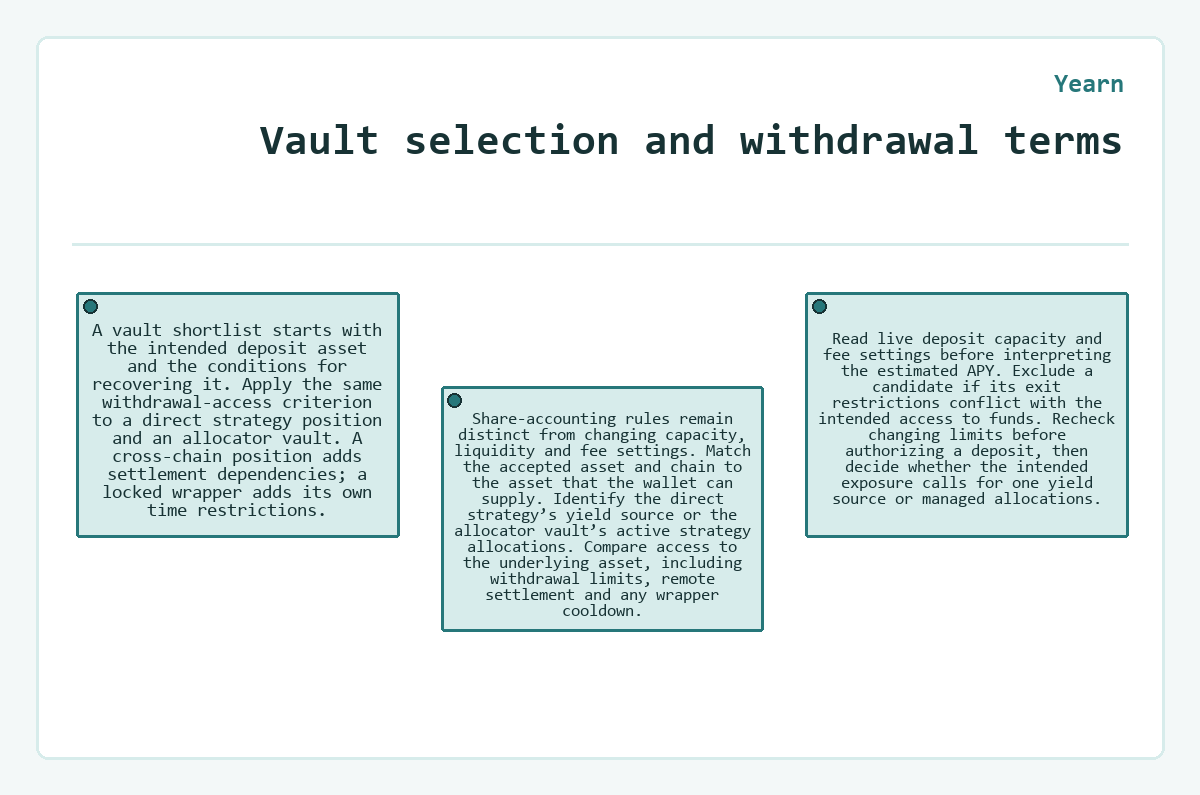
- Match the accepted asset and chain to the asset that the wallet can supply.
- Identify the direct strategy’s yield source or the allocator vault’s active strategy allocations.
- Compare access to the underlying asset, including withdrawal limits, remote settlement and any wrapper cooldown.
- Read live deposit capacity and fee settings before interpreting the estimated APY.
- Exclude a candidate if its exit restrictions conflict with the intended access to funds.
Recheck changing limits before authorizing a deposit, then decide whether the intended exposure calls for one yield source or managed allocations.
Frequently asked questions about Yearn
-
Is YFI required for ordinary vault deposits?
- Holding YFI is unnecessary for ordinary vault deposits. The selected vault’s accepted asset and live deposit rules determine access. You also need the network’s native asset for transaction costs. Governance staking has different requirements because its input asset is YFI.
-
Does approving a token create a vault position?
- A token approval grants spending permission and does not create vault shares, transfer the approved balance into a strategy or earn vault yield; a completed deposit transfers the accepted asset into the vault and creates the corresponding share position.
-
Can a liquidity-pool vault return the pool’s individual assets?
- A vault that accepts liquidity-pool tokens normally redeems into those tokens through its underlying-asset redemption flow. Recovering the pool’s individual assets then involves the pool’s own withdrawal mechanism. A supported conversion route may combine operations, with additional execution costs or slippage, so the chosen route determines the final token received.
-
Where might vault shares be held if they do not appear in my wallet?
- Vault shares can sit in a separate staking contract when the chosen deposit route includes staking. A missing wallet token entry therefore does not by itself establish that a deposit failed. The transaction receipt and the relevant vault or staking balances distinguish a completed position from a transaction that never executed.
-
Will stYFIx automatically compound its staking rewards?
- stYFIx does not automatically compound rewards. Its passive feature is delegated governance participation. Rewards accrue separately and need to be claimed in yvUSDC, a vault token. After the configured expiry period, unclaimed rewards can be reclaimed, ending the holder’s claim to those rewards. Earning additional vault yield through the reward token is different from automatically reinvesting those rewards into the governance-staking position.
-
What happens if the Locked yvUSD withdrawal window expires?
- An expired Locked yvUSD withdrawal window requires a new cooldown while the wrapper’s timing checks remain active. Management can change the cooldown and window settings. Disabling cooldown enforcement or shutting down the wrapper’s strategy can bypass the timing checks; the underlying vault’s liquidity still affects access to assets.