 Yearn
Yearn
Yearn Vault APY and Short-Term Returns
Yearn vault APY can differ from short-term returns because annualized estimates use a different time horizon from the growth of your vault shares. Reporting cadence, profit unlocking and changing strategy income can widen that gap even when the displayed calculation works as intended.
Last updated ·
Table of contents
Share-price growth measures an unchanged position’s vault return, while gas costs and withdrawal losses can change the amount you ultimately retain.
Matching the return calculation to the deposit
An unchanged vault position allows a direct share-price comparison across its holding period. If deposits, withdrawals or transfers changed the position, its personal return needs cash-flow accounting. The starting balance and ending balance alone cannot distinguish investment growth from added capital. Account for cash flows before interpreting a disappointing result or moving assets because the displayed rate looks different.
The normal comparison uses the same vault and the same underlying asset at both endpoints. When a dashboard value appears inconsistent, compare it with the vault’s conversion value using matching observation times and asset units. A percentage measured since vault inception answers a different question from the return earned since your deposit. Neither replaces the other.
Estimated yield and historical growth
A historical APY annualizes growth that already occurred, while a forward estimate models yield from the strategy’s income sources. APY means annual percentage yield and includes a compounding assumption. The label alone does not identify the calculation. Historical measurements can include seven-day, 30-day and inception windows. Each window samples different performance, so their annualized figures can disagree without describing different holdings. APR, or annual percentage rate, expresses an annual rate without the same compounding adjustment. Comparing gross APR with net APY also mixes fee treatment.
A forward estimate can combine underlying interest or trading income with applicable rewards. Its assumptions may include reward-token values and reinvestment. Those inputs can change before the deposit earns the projected yield. A historical figure also carries assumptions when extended into the future: the observed growth would have to continue. Neither calculation fixes the return for the next holding period.
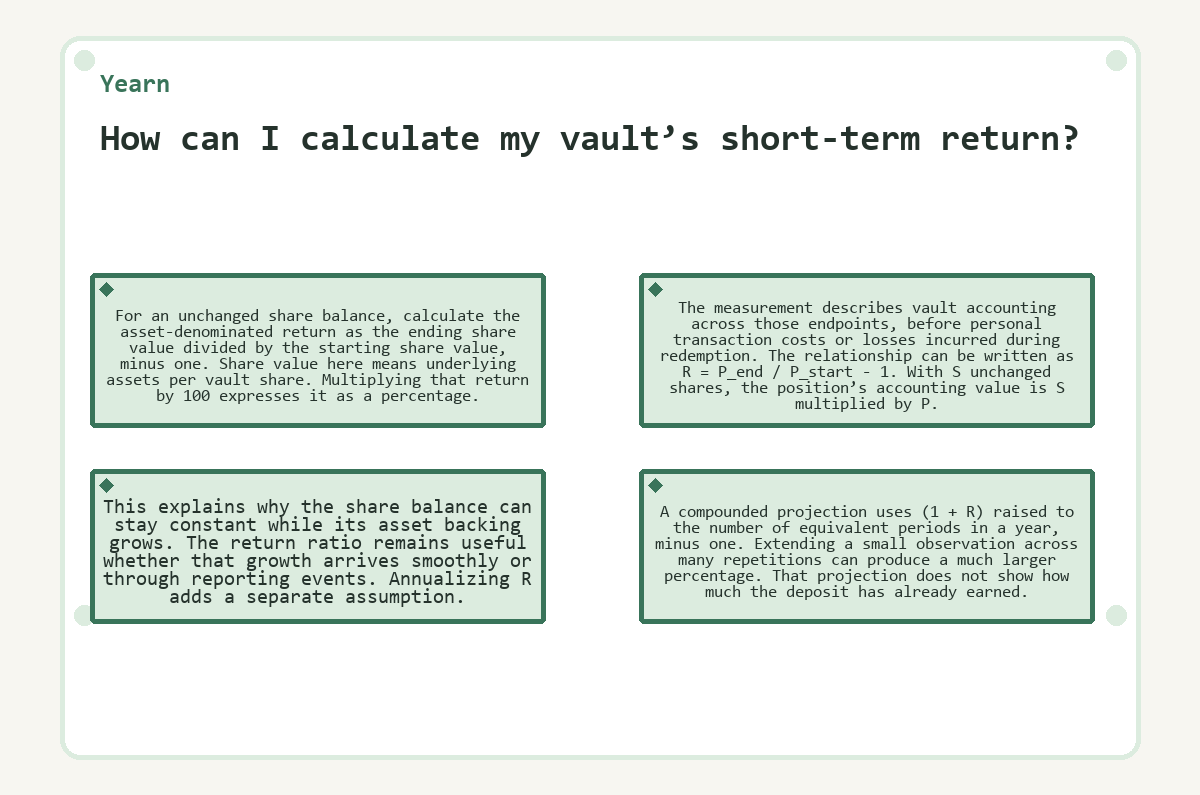
How can I calculate my vault’s short-term return?
For an unchanged share balance, calculate the asset-denominated return as the ending share value divided by the starting share value, minus one. Share value here means underlying assets per vault share. Multiplying that return by 100 expresses it as a percentage. The measurement describes vault accounting across those endpoints, before personal transaction costs or losses incurred during redemption.
The relationship can be written as R = P_end / P_start - 1. With S unchanged shares, the position’s accounting value is S multiplied by P. This explains why the share balance can stay constant while its asset backing grows. The return ratio remains useful whether that growth arrives smoothly or through reporting events.
Annualizing R adds a separate assumption. A compounded projection uses (1 + R) raised to the number of equivalent periods in a year, minus one. Extending a small observation across many repetitions can produce a much larger percentage. That projection does not show how much the deposit has already earned.
Reporting and profit recognition
A strategy’s accounting method determines when earnings affect its conversion value. Allocator vaults add another accounting layer above the strategies they fund.
Strategy-level valuation
Reported harvests
Report-based Tokenized Strategies recognize harvested gains through
report(). The strategy values its holdings, calculates gains or losses and charges applicable performance fees. Profit locking can then spread recognized gains over time. Maintenance through
tend()
can manage the position between reports without updating profit accounting under the default report-based behavior.
Accrued yield between reports
TokenizedStrategy 3.1.0 supports live asset valuation when a strategy overrides its read-only
_strategyTotalAssets()
hook. When that valuation is implemented, conversions can reflect accrued yield between reports. BaseStrategy’s default retains report-based accounting. The version number therefore does not establish that a particular strategy uses live accrual; its valuation implementation also matters.
Allocator-vault valuation
An allocator vault uses
process_report(strategy)
to compare its strategy position’s conversion value with recorded debt. It recognizes the difference as gain or loss and applies its own accounting. A strategy’s updated value can therefore precede recognition in the allocator vault. Depositors in that vault and direct strategy depositors hold different shares with different accounting layers.
Profit unlocking and deposit timing
With profit locking enabled, a V3 allocator vault spreads reported net gains into share value over its configured unlock period. The mechanism uses shares held by the vault to smooth the effect. It does not require sending each depositor a separate reward payment whenever a report occurs.
A holding period can begin or end partway through an unlock. Its measured growth then captures only the share-value change between those observations. Overlapping reports can also alter the remaining unlock schedule. Reporting frequency and unlock settings are separate inputs; a configured unlock duration does not promise that every strategy harvests on that schedule.
Profit unlocking does not create new yield. It changes when recognized gains contribute to the conversion value of depositor shares.
A hypothetical share-price calculation
This hypothetical position holds 173 shares in the same vault for 13 days. The share balance stays unchanged, and underlying assets per share rise from 1.083 to 1.089. Both values already reflect the vault accounting at their respective observations. Personal transaction costs remain outside the calculation.
Before treating the difference as vault growth, the reader confirms that both observations concern the same vault and asset. The position has no intervening deposits, withdrawals or share transfers.
The starting accounting value is 173 multiplied by 1.083, or 187.359 vault-asset units. The ending value is 173 multiplied by 1.089, or 188.397 units. Subtracting gives a gain of 1.038 units. Dividing that gain by the starting value gives approximately 0.554% over the 13-day holding period.
The gain is an accounting-value increase, not a record of tokens received from a withdrawal. An annualized dashboard estimate describes a different time horizon. If a transfer or additional deposit occurred, the calculation would need the associated cash flow. If a withdrawal later realizes a loss, its received amount becomes a different endpoint.
Net vault yield and personal transaction costs
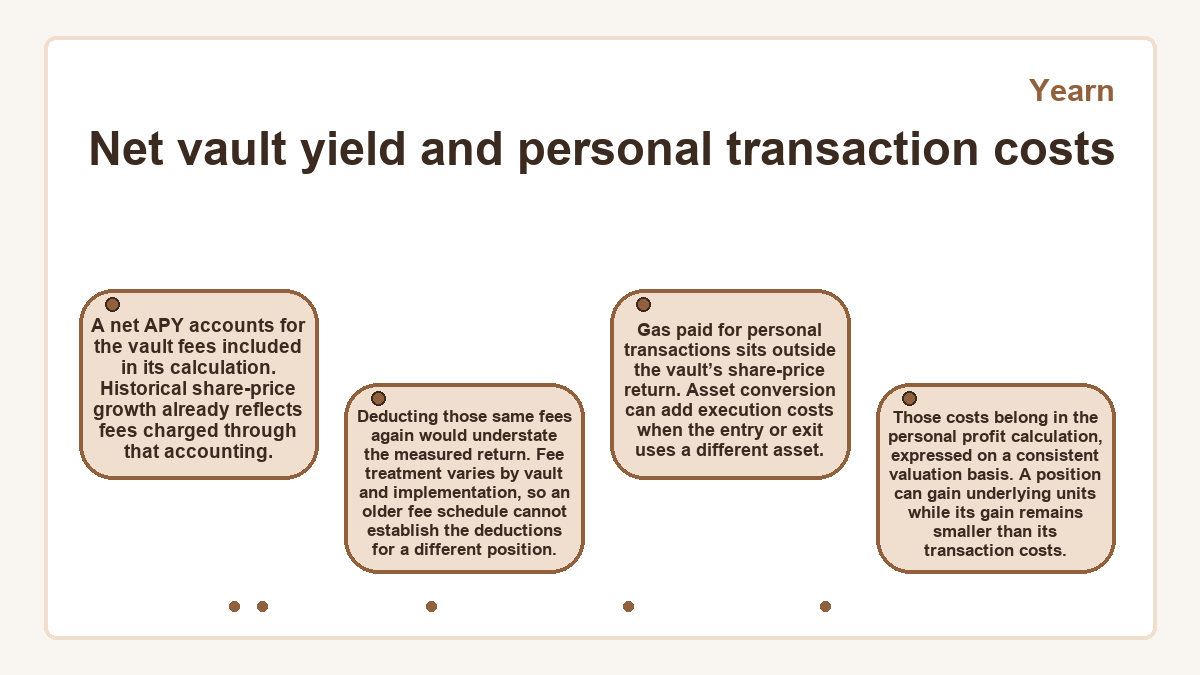
A net APY accounts for the vault fees included in its calculation. Historical share-price growth already reflects fees charged through that accounting. Deducting those same fees again would understate the measured return. Fee treatment varies by vault and implementation, so an older fee schedule cannot establish the deductions for a different position.
Gas paid for personal transactions sits outside the vault’s share-price return. Asset conversion can add execution costs when the entry or exit uses a different asset. Those costs belong in the personal profit calculation, expressed on a consistent valuation basis. A position can gain underlying units while its gain remains smaller than its transaction costs.
What can make the displayed APY change?
A displayed APY can change when strategy income, reward values or the measurement window changes. Lending income responds to the conditions of the underlying market. Trading income depends on activity in the relevant liquidity pool. Incentive-based estimates depend on reward emissions and the value realized when rewards are converted.
Allocation changes can alter the combination of income sources. V3 allocation machinery operates within strategy limits and other configured constraints. A high rate in one strategy does not establish that the entire vault can earn it. Idle assets and allocation weights also affect the aggregate estimate.
A rolling historical window changes even without a new allocation. Earlier gains leave the window as time passes, and later performance replaces them. A short window reacts faster to that change. A longer window includes more history, including conditions that may no longer apply.
Asset yield and market-price returns
A vault’s asset-denominated gain measures growth in its underlying asset, while a currency valuation also reflects that asset’s market price. More underlying units can coincide with a lower currency value. The effect applies to volatile assets and to stablecoins that lose their peg. A positive yield percentage does not describe the size of that price exposure.
A yield-bearing deposit asset adds another valuation layer. Growth measured in units of that asset can exclude growth already occurring inside the asset itself. A calculation of the combined return must account for both conversions on the same time basis. Adding unrelated annualized percentages can misstate their combined effect because they may use different windows or include overlapping income.
Accounting value and withdrawal proceeds
A share conversion gives an accounting value, while the assets received on redemption establish the completed exit. V3 vaults expose
convertToAssets()
for conversion and
maxWithdraw()
or
maxRedeem()
for withdrawal limits. A conversion read does not establish that the entire position can be redeemed immediately. Liquidity and the vault’s configured restrictions remain relevant to execution.
Unwinding a strategy can realize losses that reduce the assets received. The V3 withdraw method defaults to allowing no loss on the requested exit; redeem defaults to allowing up to 100%. A loss above the selected tolerance reverts the transaction. The actual withdrawal amount supplies the endpoint for completed performance. It can differ from an earlier conversion value even while a dashboard retains a positive 30-day APY.
Helpful answers about Yearn
Can I average daily APY readings to calculate my Yearn vault return?
An arithmetic average of displayed APYs does not calculate the return earned by your deposit. Those readings annualize estimates that can overlap in time. Realized growth over successive intervals compounds through their growth factors. For an unchanged position, the starting and ending asset-per-share values provide the holding-period return directly.
Does a falling APY remove yield already reflected in my shares?
A falling displayed APY does not by itself remove yield already reflected in your shares. It can describe lower expected income or a changing historical window. A realized strategy loss or another accounting change can reduce share value separately. The rate decline alone does not establish that such a loss occurred.
What does a missing APY mean for a new Yearn vault?
A missing APY can mean that a new vault lacks sufficient reporting or share-price history for an estimate. It does not establish that the vault has earned nothing. An unavailable historical measurement and a measured return of zero represent different information. Any forward estimate also needs its own applicable inputs.
How can token decimals distort a vault return calculation?
Mismatched decimal scaling can make a vault return calculation appear much larger or smaller than it is. Raw contract values use integer token units, while displayed values adjust those units for decimals. Both observations must use the same scaling. A consistently scaled price ratio cancels that common factor.
Which starting value applies to vault shares bought from another holder?
The purchase cost supplies the buyer’s personal starting value when vault shares were acquired from another holder. A share-price ratio measures the vault’s subsequent accounting growth, but the purchase can occur at a different exchange price. Personal performance must include that acquisition price and costs in the same valuation unit.
Can compounded rewards be counted again as separate income?
Rewards already sold and reinvested into the assets backing vault shares are included in the resulting share-price growth. Adding them again as separate profit double-counts the same income. A projected reward component in an APY breakdown also does not establish that the holder received a separate reward payment.
Will switching to another vault preserve a continuous share-price history?
Switching to a different vault requires a separate share-price series, even when the underlying asset stays the same. The two share tokens can have different conversion ratios and accounting. Personal performance across the move uses the value carried between positions and the intervening costs; splicing their share prices creates a misleading return.
Are two deposits in the same vault supposed to earn identical personal returns?
Two unchanged positions measured over identical entry and exit times have the same asset-denominated share-price return before personal transaction costs. Different deposit dates can capture different reports, unlock intervals and market conditions. Costs can also differ between transactions, so sharing a vault does not establish an identical personal result.